Before you start
- A brand or project brief with an audience, goal and constraints.
- A tool for assembling the board, or a connected AI that can create a supported HTML board. Stash is the review destination, not a native moodboard editor.
The workflow
- 01
Turn vague adjectives into a brief
Ask what “warm”, “bold” or “premium” should mean for the audience. For a workshop, warmth might mean approachable language and tactile materials rather than expensive finishes. Write down the desired impression and the action the board should eventually support.
- 02
Propose genuinely different directions
Ask AI for three routes with a name, rationale, palette, type character and imagery approach. Keep the same brief for each route. “Warm editorial”, “bright playful” and “quiet documentary” give reviewers meaningful choices; three near-identical collections with different names do not.
- 03
Assemble and explain the references
Use Canva, Figma or another board tool to arrange the chosen references, or ask an AI to create a simple HTML board. Include a sentence under each reference explaining its role. Verify asset provenance and permitted use before using imagery in final deliverables. A reference is inspiration, not automatic permission to reuse it.
- 04
Export or publish the board for review
Export the board as PNG for annotation, or publish the supported HTML version privately. Ask reviewers whether the direction fits the audience and what feels inconsistent. If selecting among boards, export comparable images and use a design vote with a brief-based question.
- 05
Turn the chosen board into rules
After selecting a direction, write three to five reusable rules such as “one warm accent, large readable dates, candid workshop imagery”. Record why the other directions were rejected. Apply those rules to one small design and review it; a board is useful when it changes the next design decision.
WORKED EXAMPLE
Three directions for the same workshop
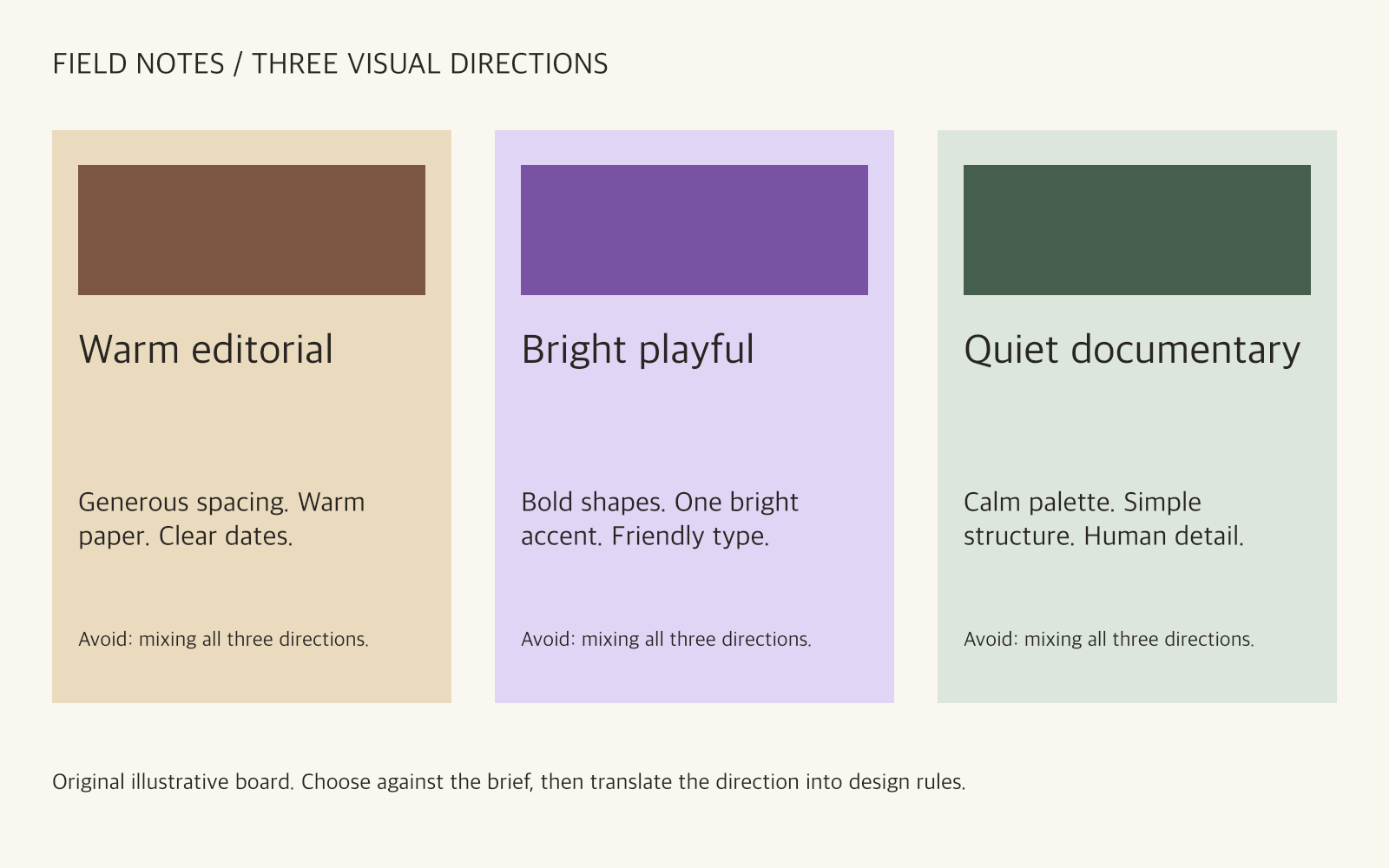
The included illustrative board contrasts Warm editorial, Bright playful and Quiet documentary using original colour and type treatments. It contains no licensed reference photography.
Starting point
A mixed collage combines playful stickers, luxury product shots and muted architecture without explaining which qualities belong together.
A clearer result
Three separate directions each have a rationale and a short “use / avoid” note. The team chooses one against the same audience brief.
Check the result
- Each reference or treatment has a role.
- Directions differ in more than colour.
- The selected direction becomes practical design rules.
Original practice files
Fictional examples made for these guides. Download them to try the workflow with your own tools.
A prompt you can use
Replace the bracketed fields with your project details. Check what the AI can access before requesting changes.
Using this brief [brief], propose three distinct visual directions. For each, give a name, audience rationale, palette roles, type character, imagery approach and three use/avoid rules. Mark assumptions and suggest reference categories rather than inventing source links. Finish with one question that would help a client choose between the directions.Download the brief, prompt and checklist ↓
Questions & answers
How do I make a useful AI moodboard from a brand brief?
Start from the brief, use AI to propose distinct directions, assemble purposeful references in a design tool and review the resulting board. Stash can collect comments or votes on exported boards or supported HTML artifacts.
How do I turn a vague client brief into three visual directions?
Clarify the audience and intended impression, then propose three routes with different visual principles. Explain the tradeoffs of each and ask the client to choose against the brief.
Can I edit a native moodboard inside Stash?
Stash is not a native moodboard editor. Assemble the board in your preferred design tool, or create a supported HTML artifact with AI, then use Stash for review and versions.
What should happen after the client chooses a direction?
Write a few actionable rules and apply them to a small real deliverable. Review that design before extending the direction across a whole campaign.
Keep in mind
- AI-generated references and descriptions need human judgment. Do not present them as verified assets or permission to reuse someone else’s imagery.
Put it into practice.
Start with the example or bring a small project of your own.
Review a moodboard image ↗